This article was created to help the following people. If even one of these applies to you, I believe this article will be useful.
- Those who were researching traditional lead-acid battery inverter battery systems for installation in India, but want to know if there are other new systems that might be a better fit
- Those working remotely in India who want to eliminate the risk of power outages during online meetings
- Those who want to know simulations of long-term total costs (initial investment + maintenance costs + power conversion losses, etc.) in advance and make a purchase that won’t be a mistake from a long-term perspective
- Those who want to check product warranties in India before purchase in case of defects or troubles, and don’t want to be deceived
- Those who want to avoid the risk of troubles when requesting installation work for traditional lead-acid battery inverter battery systems or negotiating with landlords
- Those with wives who want to take measures against the odor and health hazards of traditional home batteries. Those who value the safety of small children and pets.
- Those whose power outages typically last at most half a day, and who want to reliably protect only the stable operation of work-critical equipment like PCs and Wi-Fi
- Those who want to know in advance about unexpected pitfalls when implementing power outage solutions for refrigerators, air conditioners, microwaves, and heating appliances
- Those who can compromise on power outage solutions for large appliances like refrigerators, air conditioners, and microwaves if there are greater benefits (this article also introduces original solutions)
- Those who want to know professional insider tips for power outage solutions in India
Do you believe that a conventional home inverter battery system is the only solution for power backup in your residence?
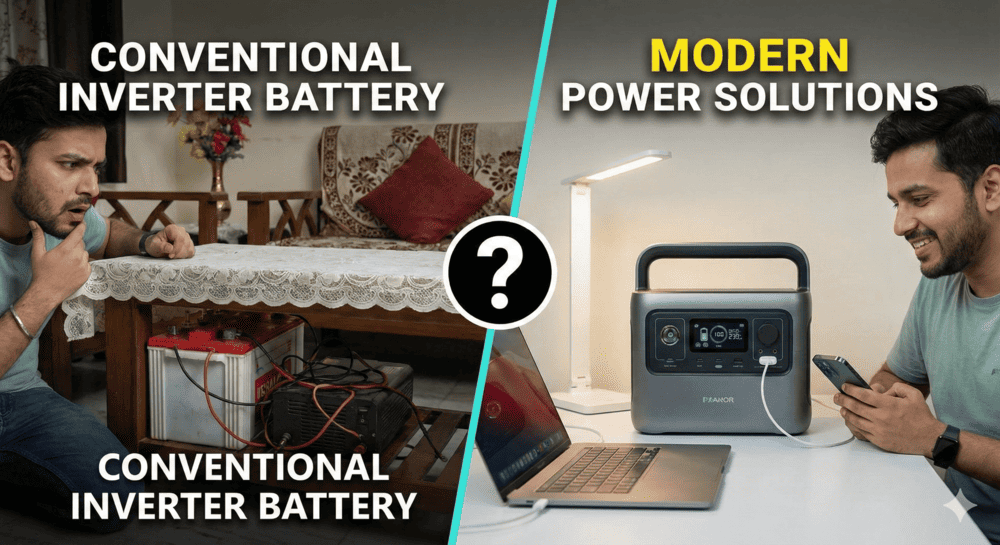
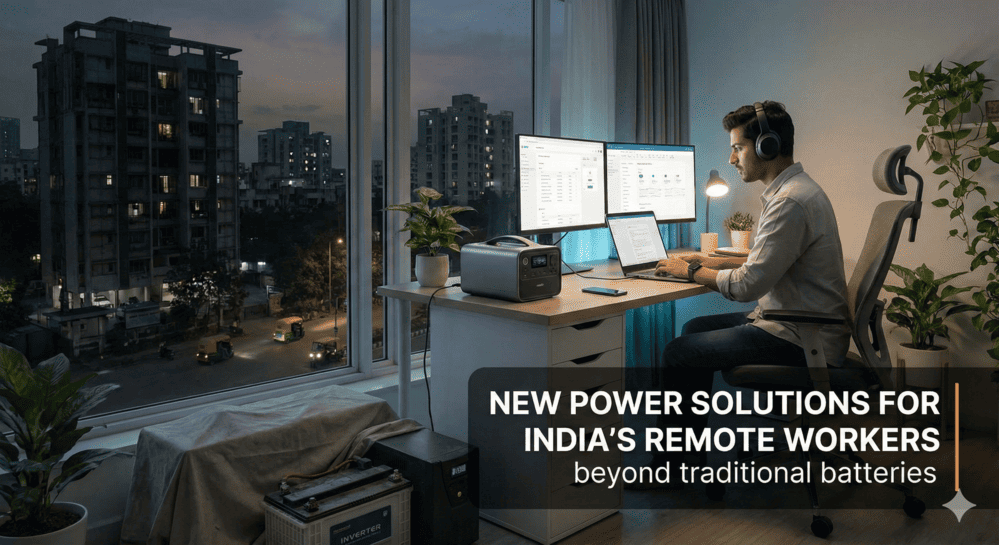
When it comes to power outage solutions in India, many people don’t consider alternatives to lead-acid battery inverter battery systems. While this was the only option available in India in the past, there are now new methods that offer lower risk and better cost-performance for remote workers.
Based on my expertise as a former R&D engineer at a major Japanese electronics manufacturer who lived in India for over 3 years, I’ve investigated this from seven practical perspectives: performance, cost, health, negotiation risks with landlords and electricians, and more. I’ll support you in discovering the right power outage solution for your needs by sharing evaluation criteria developed at a major Japanese manufacturer, local failure stories, and unique solutions from a researcher’s perspective.
Why Are Many Indians Now Dissatisfied with Traditional Lead-Acid Inverter Batteries?
Lead-acid batteries used in Indian household inverters emit chemical odors. This smell is far more problematic than you might imagine for those who are sensitive to it, so careful consideration of the installation location is necessary. I myself had a bitter experience where my wife strongly confronted me because of this odor, saying, “I can’t stand this smell. What’s more important to you—your family’s health or the battery? Move it somewhere else right now!”
I never imagined it would threaten my family’s peace before even affecting work efficiency. Moreover, depending on wind direction and strength, this odor can drift even when installed far from living spaces. In fact, after installation, I ended up deciding to relocate it about twice, thinking “Let’s move it after all.”
Furthermore, these batteries are surprisingly heavy, weighing over 50kg, and have wiring and thin plastic protrusions, making relocation after installation nerve-wracking. When trying to move it forcefully, I worried “Will I hurt my back?” and because of the small plastic protrusion parts, I also thought “What if it breaks during relocation…” Additionally, if you place it outdoors or on a balcony to avoid the smell, it gets exposed to India’s characteristic dust and sand, which tends to shorten the equipment’s lifespan. There’s a constant feeling of uncertainty and accompanying risks.
In terms of operation, there’s the hassle of regular distilled water refills. The frequency is about once every few months to half a year, so you might think it’s not much trouble. However, this isn’t a simple task of just adding water—it requires careful attention and technique to prevent dust and debris from entering inside.
Since it’s placed outdoors, dust easily accumulates on the lid, and this dust gets into the grooves, making cleaning difficult. In my case, I made a small mistake, and when I opened the device’s lid, some dust got into the electrolyte, which made me anxious, thinking “What if it breaks?”
This anxiety lingered for a long time afterward, and I often thought “What if it breaks during an important online meeting…” Such maintenance is quite nerve-wracking, and since you can’t easily delegate it to others for fear they might damage it, you need to do it yourself.
Currently, in India’s remote work environment, dissatisfaction with such installation inconveniences and fragility is visibly increasing.
The Portable Power Station Option That Indian Remote Workers Are Paying Attention To
The chemical odor problem that existed with traditional inverter battery systems has been solved with portable power stations. You can think of this as essentially “a large mobile battery with power outlets.” Portable power stations emit no harmful gases, so they’re odorless and clean even when placed in bedrooms or studies. This way, unlike my experience, you won’t be confronted by your wife with “What’s more important—your family’s health or the battery?” and the whole family can live with peace of mind.
Next, the heavy weight and dust concerns. Portable power stations are lightweight, so there’s no worry about hurting your back during relocation or breaking plastic parts by forcing movement. Since they can be managed indoors, there’s no risk of sand and dust infiltrating the interior as there would be when installed on a balcony. You don’t have to worry about dust getting in the moment you open the lid or desperately cleaning dust accumulated in grooves.
In terms of operation, they’re completely maintenance-free. You won’t be struck by unexpected anxiety during important online meetings, thinking “What if my PC breaks due to insufficient maintenance…” The latest lithium iron phosphate technology has a lifespan of at least 10 years and reliably protects expensive PCs from India’s harsh power grid. Portable power stations provide the peace of mind that they will work reliably whenever needed.
Whole House or Dedicated Workspace? Organizing Priorities to Protect Performance
When I previously considered power outage solutions in India, I wanted to back up all household appliances. However, what I learned from actual operation was that this “whole house” approach not only increased costs and hassle but also added unnecessary worries and troubles.
In my case, initially, the electrician unintentionally included the kitchen refrigerator in the backup system, which turned out to be a major mistake. The inverter’s performance couldn’t handle the load during the refrigerator’s startup, causing fuses to blow repeatedly. Each time, I had to call the contractor and went through futile negotiations and repairs, and the stress of dealing with the contractor made it impossible to focus on work.
In India’s case, I think what you want to avoid most—more than the power outages themselves—is having your work concentration drained and becoming mentally exhausted by such unexpected troubles. The most important thing during remote work is not to be worn down each time there’s a power outage, thinking “Am I going to have to deal with the contractor again…”
In other words, I think it’s better to avoid making the entire system too large and increasing unnecessary risks. In conclusion, after experiencing various unexpected troubles, I decided to focus my protection on the bare minimum—the desk area—to ensure reliable protection during power outages. As for the refrigerator and cooling solutions, I devised and solved them using unique methods I’ll describe later.
[Comprehensive Comparison] Portable Power Station vs Traditional Inverter: 7 Key Categories
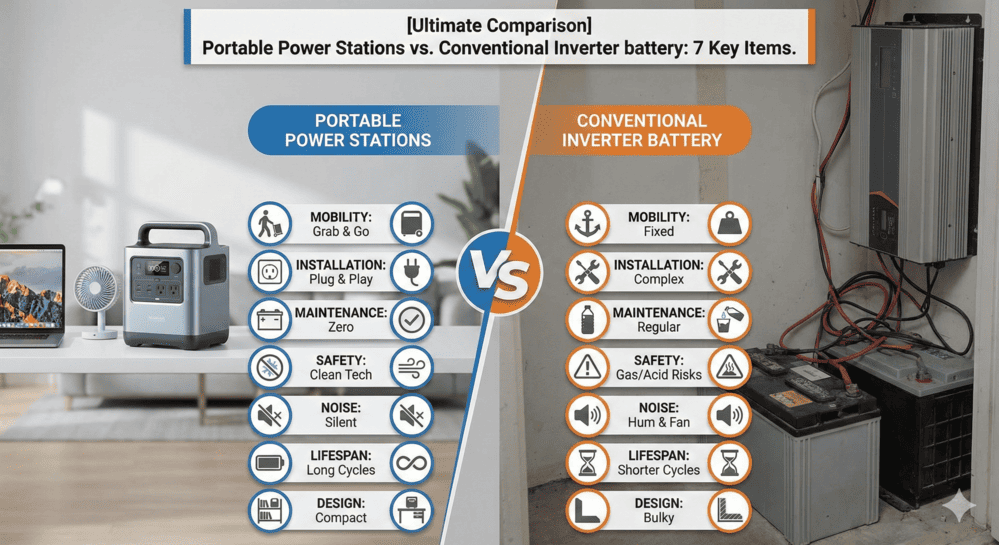
For power outage solutions in India, a simple price comparison isn’t sufficient. I think it’s good to research not only performance and cost, but also specific ways to avoid troubles after purchase and unique usage methods not even mentioned in manuals. Based on my own failures, I’ll share all the exclusive information only available in this article without holding anything back.
The Advantage of Portable Power Stations: Zero Troubles with Contractors or Landlords
In Indian rental properties, the installation work associated with inverter battery systems can become a source of trouble with landlords. If you can avoid the risks of move-in/move-out troubles and repair costs, it’s better to do so for peace of mind.
With a portable power station, since it’s like a giant mobile battery, installation is complete simply by plugging it into an outlet. Since no installation work is required, there’s no worry about wiring mistakes by local contractors or associated troubles like fires. The ability to secure a reliable and safe power source by yourself without specialized knowledge is an advantage that’s hard to appreciate before purchase.
Also, from my experience of living in India for over 3 years, the ease during relocation cannot be ignored. There are advantages in terms of trouble risks when arranging movers again, relocation time, and money. Looking beyond just current living to future relocations, portable power stations are very easy to manage.
(Personal Experience) Post-Commitment Price Gouging When Requesting Electrical Work
In my case, despite the wiring work normally being completed in one visit, the electrical technician came about 5 times, and what should have cost 500 rupees ended up costing me a total of 3,500 rupees in extortion. Eventually, this electrical technician didn’t keep his promises and no matter how many times I called him, the work wasn’t completed, so I said this to the technician:
“If this work isn’t completed, I can’t proceed with my work. Therefore, I can’t let you go home until this work is finished. I’ve called you many times, so if you don’t complete this work quickly, I will call the police.” I had to force the completion of the work this way.
When this happens, it becomes difficult to hire this electrician next time, and the anxiety that other contractors are probably similar lingers. With a portable power station, installation is complete simply by plugging it into an outlet as a regular appliance.
The Truth About Health Hazards and Odors: Comparing Dilute Sulfuric Acid Gas and Chemical Odor Risks from Lead-Acid Batteries vs Completely Odorless Portable Power Station
Lead-acid battery-based inverter battery systems commonly used in Indian homes emit distinctive chemical odors containing dilute sulfuric acid gas during charging and discharging processes. This is not merely an odor problem—in poorly ventilated indoor spaces, it carries health risks that can cause throat pain and headaches.
During my over 3 years living in India, my wife actually fell ill due to this odor. As mentioned earlier, this smell caused conflicts with my wife and forced me to relocate the installation twice. No matter how high-performance an inverter battery system is, structurally, anxiety about toxic gas constantly lingers in your living space.
Especially for families with small children or pets, this invisible risk can become a price to pay far greater than any amount of money saved. In this regard, a portable power station is, so to speak, “like a giant mobile battery with power outlets,” adopting the latest sealed lithium-ion batteries, and generates no gas or odor during use.
Being completely odorless and clean, you can continue working in consistently fresh air without harming your health, even when placed right next to your bedroom or desk. It protects your family’s health while maintaining a peaceful home environment. This added value brought by air quality is one reason why portable power stations are chosen for remote work.
PPS Specialized for Work Equipment or Traditional Systems That Power Large Appliances
The biggest difference between portable power stations and traditional inverter battery systems lies in their design purpose. As I failed to do previously, if you get greedy and try to back up large appliances like refrigerators, the system can’t withstand the sudden current surge during startup, fuses blow, and the entire system goes silent.
Having Wi-Fi and PC suddenly cut out during work and then having to call contractors is a scenario you want to avoid. Furthermore, if you’ve had even one dispute with an electrician like I did, I don’t think they’ll come to help next time. When working from home, this scenario lurks as the biggest invisible potential risk.
In other words, to give a simple example, when implementing power outage solutions for 10 devices versus 3 devices, the latter overwhelmingly reduces trouble risks. Therefore, I realized that the key to surviving in India is to abandon the whole-house approach of trying to power everything and instead protect only your work lifeline in isolation. For remote workers, I believe this selection and focus is the way to protect your career and peace of mind.
Latest Batteries Lasting 10-60 Years with Zero Maintenance vs Lead Batteries Requiring Distilled Water Refills
In India where unexpected troubles occur frequently, I think ease of maintenance directly impacts quality of life (QOL) more than you might expect. Traditional lead-acid battery inverter battery systems require distilled water refills every few months. Before purchasing, I thought this task would be “just adding water.” However, when I actually did it, it was a much higher hurdle than I imagined.
This is because the refill work had a major pitfall: dust. Dust that has been exposed to outside air for long periods accumulates in the lid grooves and is difficult to completely remove. I experienced the risk of dust entering the internal electrolyte the moment you open it, leading to malfunction. Despite being very careful initially, I contaminated the electrolyte with dust and the anxiety lingered for a while: “If this breaks, what will happen to my work?”
On the other hand, a portable power station is “like a giant mobile battery,” so it’s completely maintenance-free. With lithium iron phosphate technology boasting a lifespan of at least 10 to 60 years (over 3,000 cycles), there’s no need to open that heavy lid and battle dust.
The peace of mind of a once-in-a-lifetime purchase with nothing else to do afterward has more value than you might think.
UPS Function to Protect Desktop PCs from Momentary Power Interruptions
One key point in India’s power outage solutions is the momentary interruption that occurs the instant electricity cuts out. Cheap inverters can take 30-50 milliseconds or more to switch power supply, and in that brief gap, desktop PCs and internet Wi-Fi routers shut down. In this case, communication is cut off during online meetings, causing trouble as you wait for a restart.
The problem here is the opacity that you can’t know whether UPS units sold in India can actually handle momentary interruptions until you purchase one and a power outage occurs. It’s not uncommon for published specifications to differ from actual performance, and we have to gamble by paying thousands of rupees.
Especially during client meetings, sudden disconnections can create distrust. In this regard, the latest portable power stations have UPS functions that guarantee switching under 20 milliseconds by global standards, continuing power supply so smoothly you won’t even notice a power outage occurred.
Design Suitable for Placement Next to Indoor Desk or Installation on Balcony
Traditional Indian inverter battery systems are not beautiful by any stretch, and with thick wiring and exposed battery terminals, there’s electrocution risk, requiring caution for families with small children or pets.
The more complex the connection terminals and wiring become, the higher the risk of malfunction and accidents. For example, small children could trip over this tangled wiring and fall, the impact could break heavy equipment, and in the worst case, there’s the risk of electrocution from exposed terminals.
On the other hand, portable power stations are all-in-one designs where all functions are packaged in the housing as a giant mobile battery. No complex wiring, no exposed terminals. You can protect what you definitely want to safeguard during power outages—PCs, routers, desk lamps, etc.—simply by directly connecting them. This simple configuration protects your family from unforeseen accidents.
Being able to place it next to your study desk and operate it at ideal room temperature suppresses battery degradation, allowing operation with a long lifespan of at least 10 to 60 years. Portable power stations combining this safety with system robustness can be a choice that supports remote work in India.
Sharing Unique Solutions and Diagnostic Methods from This Article
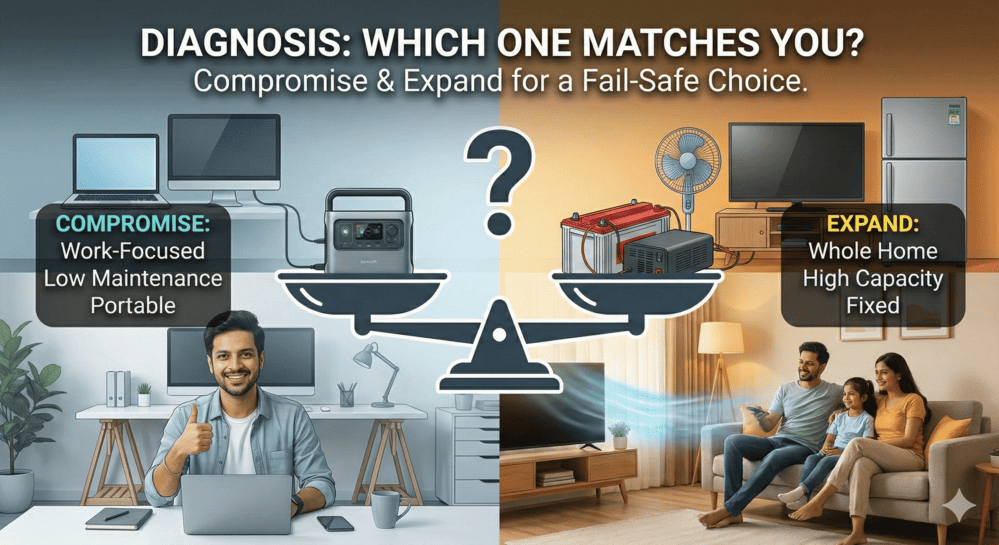
If I may share from my real experience as a former R&D employee at a major electronics manufacturer, I believe trying to cover all power outage solutions for your entire home in India is actually a high-risk choice. This is because the more complex the system becomes and the longer the period, the greater the risks. Here, I’ll share only in this article the compromise solutions I practice to reliably protect my work from power outages and my unique solutions to supplement them. I’ll share with you practical wisdom for surviving in India that isn’t listed in specification sheets.
For Power Outages of 4-6 Hours, Refrigerator Backup Is Unnecessary
Many people have the anxiety that power outage = refrigerator stops and all food is ruined. However, this worry is actually a bit excessive. Modern refrigerators have excellent insulation, and if you don’t open and close the door repeatedly during a power outage, they can maintain internal temperature for 4-6 hours.
As I failed to do previously, trying to back up the refrigerator as well requires making the entire system overspec to withstand the huge load (surge) during compressor startup. I can’t really recommend carrying the risk of adding tens of thousands of rupees to the system price to protect a few thousand rupees worth of food, and most importantly, having fuses blow and needing to request an electrical technician.
Also, even if the power outage is prolonged, the original solution I’ll describe later is sufficient. In my India life, it was realistic to invest the saved budget in a higher quality portable power station and make only the PC environment I absolutely must protect rock-solid.
Unexpected Pitfalls When Implementing Power Outage Solutions for Large Appliances
As mentioned earlier, I initially wanted to run the air conditioner, but actually stopped. One technical reason for this is the magnitude of stress on the inverter battery system.
For example, just the PC area and cooling fans around the desk don’t consume even 500W. However, when adding air conditioners, microwaves, and refrigerators, it’s quite conceivable to exceed 2000W. In other words, comparing 500W and 2000W, the equipment lifespan changes by a factor of 4.
This is a major point that affects lifespan. Moreover, a major reason is that I was able to almost completely substitute for high-load appliances with the unique cooling life hack I’ll share in the next section.
For AC Power Outage Solutions, Traditional Systems Are the Only Choice | What’s the Trick Using PET Bottle Ice?
If you absolutely want to use air conditioning (AC) during power outages, to be honest, you have no choice but to set up a large traditional inverter battery system. However, this comes with the costs of odor, noise, short lifespan, and contractor troubles I mentioned before.
So, let me share a cooling life hack for portable power station users that I, as a former R&D professional, practiced in India. Instead of air conditioning, use 2-liter frozen PET bottles wrapped in towels. Pinpoint cool areas where major blood arteries are located, such as under your arms or between your legs. Actually, cooling these major arteries in your body allows cold blood to efficiently circulate throughout your body, giving your entire body a cooling effect.
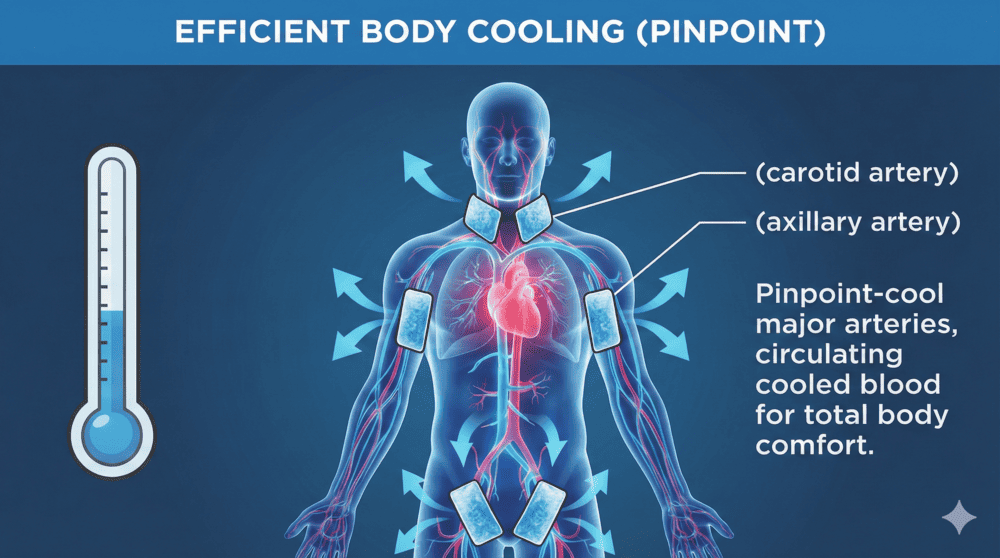
In other words, while you can’t cool the entire room like air conditioning, you can efficiently cool only the inside of your body in a pinpointed manner. With this method, I was able to spend comfortably even during the hottest period from March to May. It also lasts about 5 hours when sleeping at night, so I got a good sleep effect.
This cooling effect improved my QOL more than I expected. Also, if you want to “cool more effectively for longer periods,” you can use these cheap ice packs. Since you can use them for life with one purchase, they’re a good deal.

Portable Power Stations Can Be Expanded with Solar Panels and External Batteries
Still, the anxiety “What if the power outage exceeds 24 hours?” may remain. With traditional inverter battery systems, adding batteries later requires rewiring, creating the risk of another dispute with that electrician.
However, portable power stations can be expanded after purchasing capacity. Just connect an external battery with a single cable—it takes less than 10 minutes to easily double or triple the capacity. Furthermore, by placing a solar panel on the balcony and connecting it to the portable power station, you can keep your PC, Wi-Fi, and LED lights running on solar power alone no matter how many days the power outage continues.
Start with the minimum size necessary for work and power up later as needed. This ability to start without failure after purchase is the decisive point where traditional lead-acid battery inverter battery systems and portable power stations fundamentally differ.
Conclusion: If You Don’t Want to Take Overall Risks, Portable Power Stations Are the Top Candidate
Looking back on everything, I’ll state my conclusion. If you’re an IT professional with the possibility of relocating every few years, I believe portable power stations are the top candidate with the lowest risk. This is because inverter battery systems are like real estate that’s difficult to move once installed. The risk of troubles with landlords and electrical contractors can become an invisible risk that interferes with your work.
On the other hand, portable power stations can be easily carried by hand and are complete with a single power outlet. On moving day, just carry it out along with your suitcase, and you can recreate a 100% work environment from day one even in a new home. The experience of your worries disappearing the moment you buy it is an advantage that’s hard to notice until troubles occur.
The low-cost ice bottle method, expandability through solar panels and external batteries that enable constant availability—these aren’t listed in catalog specifications, but I believe they become key points in practical use.
Spec Calculations: How Many Hours Can You Run a MacBook and Monitor?
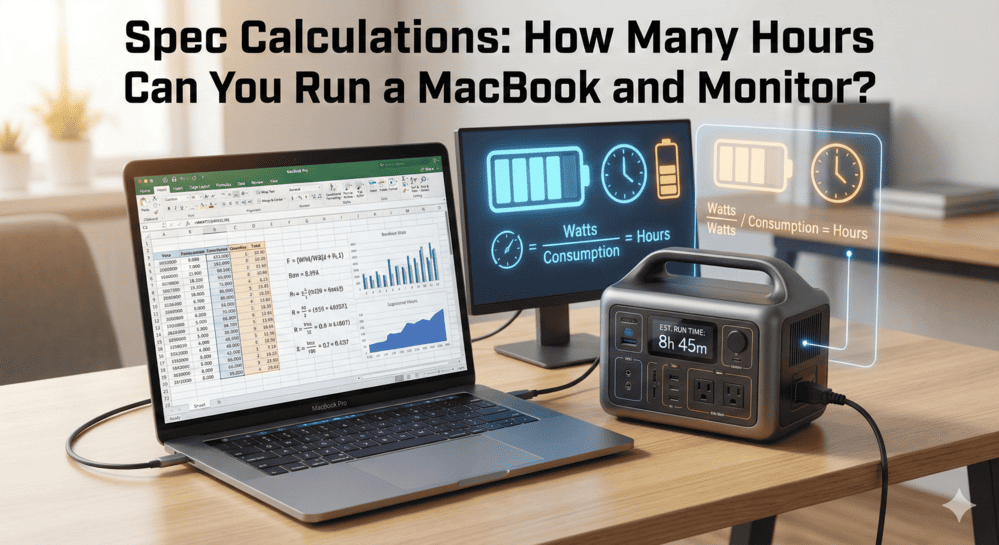
In this chapter, we’ll work through actual simulations. I’ll also share blind spots in simulations that many people aren’t aware of.
The Blind Spot in Simulations That Many People Get Wrong
Originally, what’s important when building a system is that you should simulate with average power consumption in actual usage environments, but the pitfall is calculating with the catalog power specifications. Let me give you an example.
For instance, in my case, my laptop PC’s power supply is 65W, but I do a lot of lightweight work like blogging and spreadsheets, and even using energy-saving mode has almost no impact on work speed, so I actually only use an average of about 20W. With 65W versus 20W, the equipment you need to prepare is completely different.
This is important, so let me give another example. For MacBook Pro, the power supply unit is typically 70W to 140W. Many remote workers configure their systems based on this power consumption, which results in quite an overspec setup. However, in most real environments, even when using energy-saving mode, you often only use about 15W without feeling any performance degradation at all.
How to Calculate Actual Simulations
Only the following formula is used. Nothing else. It’s very simple.
Operating time (h) = PS capacity (Wh) × 0.85 ÷ Total power consumption (W)
Let me give you an actual example.
Calculation example:
MacBook Pro (energy-saving mode) 15W + external monitor 15W + router 10W = total 40W
500Wh model: 500 × 0.85 ÷ 40 = 10.625 hours 1000Wh model: 1000 × 0.85 ÷ 40 = 21.25 hours
※ The conversion factor of 0.85 is a realistic conversion efficiency that accounts for loss during power conversion.
If your maximum power outage time is 8 hours or less, you can see that a 500Wh class power outage solution is sufficient unless you have heavy PC work.
By the way, my configuration is as follows:
Energy-efficient laptop PC (Swiftedge 16-inch): approximately 21W
4K 16-inch external monitor: approximately 12W
Router: approximately 10W
Total 44W = 21W + 13W + 10W
500Wh model: 500 × 0.85 ÷ 44 = 9.66 hours 1000Wh model: 1000 × 0.85 ÷ 34 = 19.32 hours
From the above, even with 500Wh, you can work practically all day.As shown above, you can work practically all day, and even 500Wh is overspec.The trick is to use the energy-saving function installed in many laptop PCs.Not many people are using this excellent function, so I’ll introduce this insider tip here as well.In fact, for simple tasks only, most people will hardly feel any performance degradation even when using this energy-saving function.
Furthermore, by using this energy-saving function, the burden on the CPU and memory is reduced, so it’s possible to significantly extend the lifespan of your laptop PC.You can try this with no risk, so please give it a try.If you feel your laptop PC’s performance has degraded, you can simply turn off this energy-saving function.
In other words, by using this energy-saving function, it becomes possible to significantly extend the lifespan of both your laptop PC and portable power station.
How to Reduce Construction Costs and Significantly Extend Lifespan
Not many people are using this excellent function, so I’ll introduce this tip here again. This tip is to use the energy-saving function installed in many laptop PCs. In fact, for simple tasks only, most people will hardly feel any performance degradation even when using this energy-saving function. Furthermore, by using this energy-saving function, the burden on the CPU and memory is reduced, so it’s possible to significantly extend the lifespan of your laptop PC. Many laptop manufacturers don’t actively promote this energy-saving mode because their sales drop when PCs are used for longer periods.
Energy-saving mode is a function installed in most laptop PCs, and you can try it with no risk, so please give it a try. At this time, if you feel performance has degraded, you can simply turn off this energy-saving function and revert.
In other words, by using this energy-saving function, it becomes possible to significantly extend the lifespan of both your laptop PC and portable power station.
Smart Management Through App Integration | Monitoring Remaining Power
The latest portable power stations can integrate with smartphone apps. You can monitor current power consumption and remaining time in real-time, which not only is convenient but also resolves anxiety during power outages with logical numbers. During online meetings, you can glance at the app and continue speaking with confidence, thinking “I still have 3 hours to spare.”
Simulating Total Cost Over 10 Years
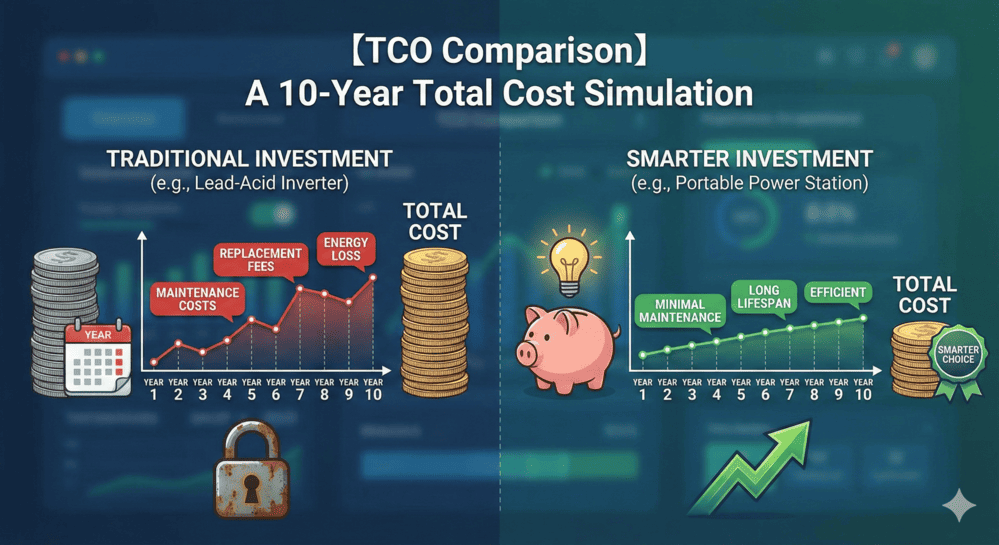
The metric for purchasing is not just initial cost but also total cost. At first glance, portable power stations may seem a bit expensive. Therefore, I’ll introduce a simulation that adds maintenance costs over 10 years, battery replacement cycles, and the invisible cost of stress.
Comparing Introduction Costs: Inverter + Battery + Electrical Work vs Portable Power Station
| Item | Traditional Inverter Set | Portable Power Station (PPS) |
|---|---|---|
| Initial Cost | Approx. ₹15,000 – ₹25,000 | Approx. ₹25,000 – ₹40,000+ |
| Installation Fee | 500 to several thousand rupees (※I’ve even been billed 100,000 rupees once) | ₹0 (Ready to use from the day it arrives) |
| Ease of Setup | Electrical work by electricians required: Risk of trouble with contractors, time loss + cannot use until work is completed | Plug-and-play: Simple and safe for anyone |
Certainly, looking at initial expenses alone, inverter battery systems are cheaper. However, you also need to compare and consider the overall picture including other factors.
Examining Hidden Costs: Lead-Acid Battery Replacement Costs and Power Conversion Loss
Replacement costs and power loss become pitfalls. Traditional lead-acid batteries can reach the end of their lifespan in about 3 years under Indian usage conditions. In other words, to continue using them for 10 years, you may need to replace batteries at least 3 times.
- Lead battery replacement cost: 10,000 rupees × 3 times = 30,000 rupees
- Hassle and risk: Each time, you must transport heavy batteries, arrange contractors, and resume maintenance battling dust and sand.
On the other hand, portable power stations have over 3,000 charge/discharge cycles, meaning a lifespan of at least 10 years or more. This means that with power outages about once a week, a battery lifespan of theoretically 3,000 weeks = approximately 57 years is not a dream.
Furthermore, the waste of electricity costs due to standby power drain and conversion loss specific to inverter battery systems is minimized with portable power stations equipped with the latest circuitry.
Reducing Trouble Risks with Landlords and Electrical Contractors to Zero
For remote workers in India, moving is a major event. Each time, as mentioned earlier, with inverter battery systems, you’re hit with trouble risks involving landlords and electrical contractors. With portable power stations, this risk is zero. It’s difficult to convert this peace of mind and time efficiency into monetary value, but considering your hourly wage, I think you can recoup the cost just by avoiding contractor troubles even a few times.
I’ve Never Been Refused a Refund on Amazon India
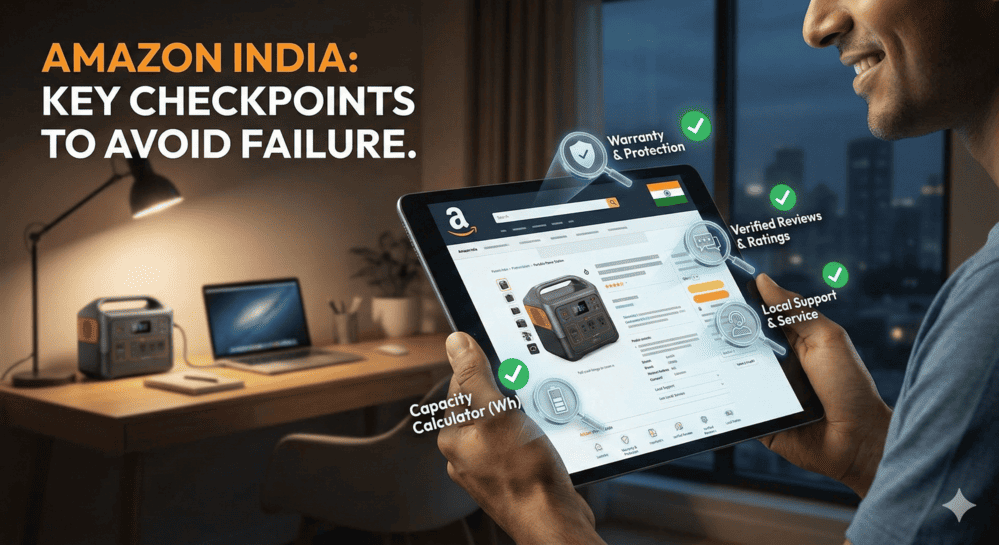
This was very surprising to me in a good way, so I’ll share it. Over these 3 years, I’ve shopped countless times on Amazon India and encountered many defective products and poor-quality items. However, with Amazon India, I’ve never once been refused a refund or exchange. That’s why I try to purchase from official stores on Amazon India whenever possible.
[Peace of Mind Guarantee] Why Amazon Protects You Even with Defective Products
When purchasing expensive appliances in India, the scariest thing is when they don’t work the moment they arrive. However, Amazon India has a powerful A-to-Z Guarantee. If you receive a product different from what was described or there’s a defect, Amazon mediates on your behalf and supports refunds or exchanges.
Here’s an important point to share. Sellers don’t want trouble with Amazon India because they won’t be able to sell their products on Amazon India, so they almost always willingly comply with Amazon India’s mediation. This guarantee is the biggest reason I use Amazon India. Amazon India values customer repeat purchases the most, so they want to thoroughly eliminate fraudulent sellers and readily agree to refunds.
The procedure for this support is simple for anyone. You can communicate via chat or call Amazon India customer support directly by phone for quick refund responses. However, please note one thing: you cannot return items due to personal reasons at your own discretion. This is the same as any appliance store, so please keep this in mind. Careful advance research to prevent failures is most important.
Reliability Check: Protection Features That Withstand India’s Voltage Surges
India’s power situation is unstable. Sudden voltage surges of thousands of volts can instantly burn out the circuit boards of precision electronic equipment. When choosing a portable power station, I think it’s best to select a globally proven and trusted brand like EcoFlow, known for high-quality surge protection and battery management systems (BMS). EcoFlow has gained solid recognition even in Japan, where technical specifications and quality standards are very strict.
Local Indian Support Systems and Manufacturer Warranties
EcoFlow is currently strengthening its service network throughout India. The era of having to send broken items overseas is over. Please also be sure to check whether the seller on Amazon India is the brand’s official store. This is because purchasing from anywhere other than authorized dealers carries the risk of not receiving the manufacturer’s official warranty.
Summary: You Can Now Work From Home Without Fearing Power Outages!
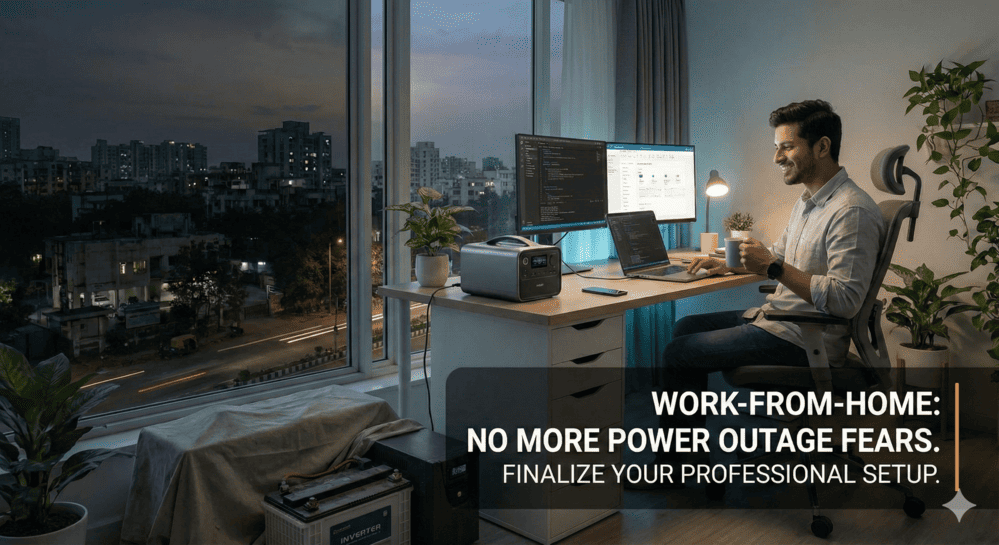
Through this comprehensive comparison, I’ve organized the reasons why portable power stations are the optimal solution for many remote workers:
- Career Guardian: UPS function under 20ms prevents the embarrassment of online meeting disconnections and data loss.
- Family Safety and Health: Eliminates risks of odors and health hazards, and accidents from tripping over complex wiring to zero, maintaining a clean and safe living space.
- Mobility: Freedom from negotiation troubles with landlords and contractors, easy portability like a suitcase when moving, and usable from day one.
- Overwhelming Cost-Performance Over 10 Years: Overall, maintenance-free with long lifespan
Even in Japan with high standards, there are three products with proven track records available on Amazon India:
ECOFLOW RIVER 3: 245Wh, 300W Up to 600W, single AC outlet, 3.5kg
ECOFLOW RIVER 2 Max: 512Wh, 1000w, double AC outlet, 6.1kg
ECOFLOW RIVER 2 Pro: 768Wh, 1600w, triple AC outlet, 8.3kg
Among these, let me explain why RIVER 2 Max is comprehensively suitable for many Japanese remote workers living in India. First, RIVER 3 has only one power outlet, so if this one outlet fails, there’s a high risk of work stopping. Also, the power capacity of 245Wh may not last half a day in some situations.
In contrast, RIVER 2 MAX has double the capacity (512Wh) compared to RIVER 3 and comes with 2 power outlets, yet the price differs by only about 20%, making it the best cost-performance. The weight is also about 6kg, so even women can carry it.
During Amazon sales, you can get it for about 30,000 rupees, so the total cost doesn’t differ much even compared to lead-acid inverter battery systems.
Furthermore, RIVER 2 MAX has a capacity of 512Wh, so for laptop PC (energy-saving mode) + sub-monitor + internet router, it provides sufficient specs for power outages of about 10 hours.
On the other hand, RIVER 2 PRO not only has a sharp price increase, but its battery capacity of 768Wh and power output of 1600W are more specs than necessary for many remote workers using laptop PCs. Moreover, if you purchase RIVER 2 MAX and find the power capacity insufficient, you can also add the external battery or solar panel mentioned earlier.
Therefore, for most remote workers, looking at the total picture, I think RIVER 2 MAX is the optimal solution.
Historical low prices during Amazon sale : 30,000rs

However, if you’re using a laptop PC or desktop PC equipped with a GPU, you should calculate the required power before considering. For most desktop PCs and laptop PCs, it doesn’t exceed 1000W, but gaming PCs sometimes do. If it exceeds 1000W, please consider purchasing RIVER 2 Pro.
Also, in my case, I don’t want to miss Amazon India discount sales, so I temporarily save items in my shopping cart and stand by for sales.