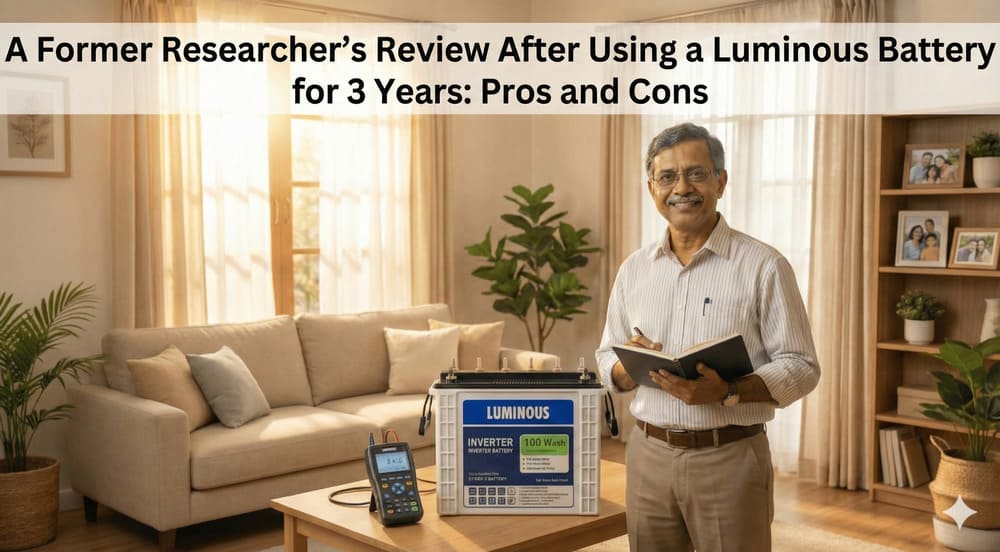
In this article, I’ll give you a comprehensive review of the Luminous battery based on three years of real-world use. I’ll cover not only the strengths that you’d never see in a product catalog, but also the honest mistakes and surprises I only discovered through actually using it. And because I come from an R&D background, I’ll also walk you through the drawbacks I identified and the practical workarounds I developed to address them.
What I Found genuinely Good About the Luminous Battery After 3 Years of Use
There was a time when every power cut meant my work ground to a halt, the fan died in the sweltering heat, and I’d lie awake through the night in sheer misery. But ever since I installed this battery, my PC, internet, and fan have never once gone down. After three years of heavy use, I’ve come to see it as more than just a piece of equipment — it’s a lifeline, a source of calm that keeps both my daily life and my sanity intact here in India. Let me share the real, practical benefits I’ve experienced, through the eyes of a former researcher.
Not Losing Power Makes a Bigger Difference Than I Expected!
Power cuts in India plunge your entire home into complete darkness without any warning. That sudden silence, and the helplessness of not being able to see anything — it’s a kind of discomfort you truly can’t understand until you’ve lived through it. One of the things I’m most grateful for since installing the Luminous battery is that it has kicked in every single time without fail. Not once has it let me down during a power cut. My internet router has never restarted due to a momentary outage, and even after three years, the Luminous battery continues to perform with rock-solid reliability.
That trust has dramatically reduced the stress of living in India. Simply knowing the lights won’t go out in the middle of the night puts the whole family at ease. Dinner no longer gets interrupted by sudden darkness, and the overall quality of our daily life has genuinely improved.
No More Anxiety About Work Being Interrupted!
As a former researcher who relies on a laptop and internet router, my biggest concern was always momentary power cuts. The UPS I used before switching to the Luminous battery broke down quickly, and every time the power flickered, my router would restart — repeatedly cutting off important online meetings with clients and leaving me in a panic.
Since switching to the Luminous battery, however, not a single online meeting has been interrupted in three years. The switchover response is incredibly fast — so smooth that my router doesn’t even seem to notice the power has gone out. And the fact that it has never once broken down makes it genuinely reassuring to rely on.
Experiencing firsthand that your work never stops is something that hits differently when you work from home. I honestly can’t imagine going back.
Distilled Water Top-Ups Were Far Less Frequent Than I Expected!
Before buying the battery, I braced myself for refills at least once every three months. I kept a close eye on it throughout the first year and topped it up regularly — but by the second year, I was amazed to find I only needed to refill it once every 10 to 12 months. Behind that dramatic shift was a decision to declutter one household appliance.
The reason: I disconnected the refrigerator from the battery. Even a small fridge draws around 300W, which places a significant load on the battery. Analyzing it with my R&D background, I realized that the higher the power consumption during an outage, the more intense the chemical reactions inside the battery — which in turn accelerated the evaporation of the electrolyte fluid.
In other words, the single most effective way to reduce the hassle of top-ups is simply not to connect unnecessary appliances to the battery. By limiting connections to only the essentials — lights, internet equipment, and ceiling fans — you free yourself from the constant upkeep of the Luminous battery and significantly extend its lifespan.
Rather than plugging everything in, it might be worth taking a step back and being selective about what you actually connect.
[Exposé] The Failures and Pitfalls You’d Never Know Without Using It Yourself
So far I’ve shared the bright side of things, but from here on I’m going to lay bare the difficult side of my three years of experience. In a place like India, it’s not just the product itself that can let you down — external factors like the installation environment and local contractors can be just as treacherous. Think of everything that follows as my hard-earned tuition fees. I’ll walk you through, one by one, what you need to know to protect yourself and your family from wasted money, unnecessary stress, and even health risks.
Topping Up Distilled Water Requires Far More Care Than You’d Expect
At first, I figured it was just a matter of pouring in some water — simple enough. But once I actually started doing it, I found it demanded a level of care I hadn’t anticipated. As a former researcher, introducing impurities into the electrolyte is an absolute no-no that directly shortens the battery’s lifespan. And the constant battle against dust and grit was nothing short of obsessive.
Before every top-up, I would clean everything meticulously — but there was a design flaw I simply couldn’t get around. The small grooves on the cell caps would collect dust that had hardened and caked together with rainwater. No matter how thoroughly I wiped them, I could never fully remove the grime lodged in those grooves, and every time I unscrewed a cap, tiny particles of dust would inevitably crumble and fall into the cell. The anxiety that caused me was genuinely maddening.
In fact, after a small amount of dust fell in on one occasion, I spent days worrying that the battery might fail in the middle of an important meeting. Completely eliminating that fine debris from the grooves is physically next to impossible, and ultimately you have no choice but to proceed knowing the risk is there. I learned firsthand just how out-of-touch with reality the phrase “simple distilled water maintenance” in the product catalog truly is. As a result, I ended up purchasing a dedicated protective case for the Luminous battery to keep dust at bay.
I Got Ripped Off by an Electrician and It Turned Into a Nightmare
As a former researcher, I had reasonable confidence in my technical knowledge — but spotting a dishonest person turned out to be an entirely different skill. I was lured in by the promise of a 500-rupee installation fee, only to have the contractor show up five separate times and ultimately squeeze nearly 3,500 rupees out of me — close to seven times the original quote — while also stealing something far more precious: my time.
The contractor would turn up at night, work for just 30 minutes, then demand payment for the day and promise to finish “tomorrow.” To make matters worse, he went ahead and connected two refrigerators — which I had never asked him to — to the inverter, overloading it and blowing the fuse. When I confronted him about it, he calmly lied and insisted he had been following my instructions. Another contractor later tried to shake me down for 100,000 rupees, claiming a full replacement was necessary.
I eventually reached my breaking point and told him bluntly, “Finish this right now or I’m calling the police,” and only then did he finally complete the job. The time and energy drained by these fruitless negotiations — before you even get to any technical issues — is the greatest loss of all. I came to realize, painfully, that the installation contractor is an “uncontrollable external factor” that poses a far bigger pitfall than any product specification.
If you move house frequently, this is something to be especially wary of.
A Health Risk: My Wife Developed Headaches from the Chemical Fumes
“Which matters more to you — your family’s health, or the battery?” — that was the impossible question my wife put to me when she could no longer endure the smell coming off the battery during charging and discharging. Lead-acid batteries like the Luminous inevitably produce acidic gases as part of their chemical process. I had dismissed it as a minor odor, but for my wife, whose sense of smell is far more sensitive than mine, it became a source of debilitating headaches.
From an R&D perspective, this odor — produced as the electrolyte evaporates — is a chemical signal that carries genuine health risks that can’t be ignored. In a well-sealed room or a poorly ventilated space, the fumes can permeate the living environment to a surprising degree. The bitter irony that a measure meant to protect my family from power outages was instead threatening my family’s health was, at the time, my biggest miscalculation and most painful mistake.
In the end, I had to relocate the battery twice, and even then, depending on which way the wind blows, the smell can still drift into the room. For households with young children or pets, this invisible risk can be an even greater pitfall than anything listed in the product catalog. To make sure you don’t repeat my mistakes, I strongly urge you to think obsessively carefully about where you place the battery before you ever bring it home.
Unique Solutions Practiced by a Former Researcher
I’d like to share some unique solutions I put into practice to tackle real challenges in the field. Before investing in expensive equipment, why not try my approach first — with minimal risk?
Power Outage Solutions for Refrigerators and Air Conditioners: Cooling the Main Arteries Directly with Ice Packs
Initially, I considered running the air conditioner on a Luminous battery, but before going that route, I tried targeted cooling using ice packs. When a power outage hits, I wrap ice packs — kept stocked in the freezer — in a towel and place them near major arteries like the armpits or groin. The cooled blood then circulates throughout the body via the arteries, allowing you to cool down effectively from the inside, even when it’s hot outside. I actually tested this method during the hottest months — March through May, when temperatures exceed 40°C — and found it so effective that I came to feel that air conditioning simply wasn’t necessary. With this method and a ceiling fan, even the most intense heat was manageable. Of course, ice packs are also useful for keeping your refrigerator cool during an outage.
Modern refrigerators can maintain their internal temperature for about four hours on their own during a power outage. But if you need protection beyond that, simply pre-freeze some ice packs and transfer them to the refrigerator when needed — it will keep your food safe for even longer. Rather than straining your battery by forcing the air conditioner to run, I found that making good use of inexpensive ice packs saves not only money and time, but also extends the life of your battery.

Using a Dedicated Case for the Luminous Battery
At first, I didn’t think a dedicated case was necessary, but I eventually added one to address the dust problem I mentioned earlier. The result was a dramatic reduction in dust buildup, and as a researcher, I was glad to have lowered the risk of contaminant exposure — a decision I have no regrets about. That said, because the back of the case is largely open, it does very little to eliminate the battery’s distinctive odor, so it’s best not to expect too much on that front.
On the other hand, I would recommend it for households with young children or pets. The battery has several thin plastic tubes protruding from it for checking water levels, and the wiring is exposed. The case physically prevents accidents such as curious hands snapping off a tube or someone getting an electric shock.
There is one catch, though: maintenance becomes significantly more labor-intensive. When refilling with distilled water, you’ll need to pull the electrolytic cell — which weighs over 50 kg — out of the case entirely. There’s a real risk of throwing out your back if you’re not careful, or of cracking one of the protruding plastic tubes against the edge of the case. Just be prepared to take on this heavy task every time you refill, as the trade-off for the safety and cleanliness the case provides.
Conclusion
After three years in India, battling through power outages with a Luminous battery, the conclusion I reached is this: the right tools, used and assembled the right way, can become your greatest allies.
The key is a shift in thinking — taking high-draw appliances like air conditioners and refrigerators off your backup power, and instead cooling yourself directly at the arteries with ice packs. Adding a dedicated case for safety and dust protection, even if it makes refilling more of a chore. It’s the accumulation of these small, self-reliant insights that makes all the difference.
Below, I’ve listed a top-rated Luminous inverter and battery combo with trolley from an authorized retailer with many positive reviews — it’s worth checking out.
(Top-Rated Selection) Luminous Inverter & Battery Combo with Trolley

I sincerely hope that the lessons I’ve learned through hard-won experience help make your life in India a little brighter and more stable.